

Importing magnets is not a price-and-lead-time exercise. A magnet shipment crosses two separate classification systems, needs a document pack that most suppliers assemble only partially, and — if it flies — has to satisfy dangerous-goods rules that have nothing to do with export control at all.
This is the checklist we use ourselves, in the order the questions actually come up. It assumes you already know whether your part is controlled; if that is still open, settle it first with our guide to the Dy/Tb classification test.
Two Classification Systems You Must Not Confuse
Almost every problem we see in magnet importing starts with these two being treated as one thing.
| HS / tariff code | Dual-use export control code | |
|---|---|---|
| What it is for | Duty calculation, trade statistics, customs procedures | Export control — whether the goods may leave China, and under what authorisation |
| Who sets it | World Customs Organization, plus national tariff lines | China’s dual-use export control catalogue (MOFCOM / GACC) |
| Typical example | 8505.11 — permanent magnets of metal | 1C905 — NdFeB containing dysprosium |
| Who needs it | Every import, always | Only shipments of controlled items |
| Format | 6 digits internationally, more nationally | Alphanumeric control code |
A sintered NdFeB magnet containing dysprosium is, for example, both HS 8505.11 and control code 1C905. The HS code tells the destination country what duty applies. The control code tells Chinese customs whether the shipment may move at all. Getting one right and the other wrong does not average out — the shipment stops.
HS Codes Commonly Used for Magnets
| Product | HS subheading | Notes |
|---|---|---|
| Sintered NdFeB permanent magnet | 8505.11 — of metal | Includes unmagnetised blanks that already have the essential character of a magnet |
| Sintered SmCo magnet | 8505.11 — of metal | Same subheading as NdFeB |
| Cast AlNiCo magnet | 8505.11 — of metal | |
| Ferrite / ceramic magnet | 8505.19 — other than of metal | |
| Bonded, flexible or rubber magnet | 8505.19 — other than of metal | The binder determines the subheading, not the magnetic powder |
| Electromagnetic coupling, clutch or brake | 8505.20 | Permanent-magnet couplings vary by national tariff line |
| Electromagnets, work holders and parts | 8505.90 |
Three cautions worth more than the table itself.
The first six digits are international; everything after that is national. The United States, for example, splits its tariff further — 8505.11.00.70 is the line for sintered neodymium-iron-boron. Your broker, not your supplier, is the authority on the destination line.
Classification follows the material, not the trade name. “Bonded magnet” made from NdFeB powder in a polymer binder is 8505.19, not 8505.11, because the article is not of metal. This trips up buyers who assume the rare-earth content settles it.
We deliberately do not publish duty rates. Tariff treatment of Chinese-origin magnets, and the trade measures layered on top of it, have changed repeatedly in recent years and differ by destination and by product line. Confirm the current rate with your broker before you quote a landed cost — a rate printed in an article is out of date the moment it is published.
The Document Pack
| Document | Issued by | What it must show | How it usually fails |
|---|---|---|---|
| Commercial invoice | Supplier | Specific product description, grade, dimensions, coating, unit price, HS code, country of origin | Generic descriptions such as “magnet” or “hardware” |
| Packing list | Supplier | Package count, gross and net weight, dimensions | Net weight of the magnets missing — needed for dangerous-goods declarations |
| Bill of lading / air waybill | Carrier | Consignee and description consistent with the invoice | Shipper or consignee mismatch after a late change |
| Certificate of origin | Chamber of commerce / CCPIT | Origin, for preferential treatment or trade measures | Requested at the last minute, delaying shipment |
| Composition test report (Dy/Tb) | Accredited laboratory | Method, limit of detection, measured values, lot identification | Not lot-specific; a report from a different batch will not match a sampled consignment |
| Control classification statement | Supplier | States the applicable catalogue code, or that the item is not controlled, referencing the test report | An assertion with no test behind it |
| Export licence (controlled items only) | MOFCOM | Covers the specific item, quantity and consignee | Applied for late; specification changed after filing |
| Magnetic flux test report | Testing provider | Field strength at 2.1 m and 4.6 m from the package | Measured before final packing, so invalid after repacking |
| RoHS / REACH declarations | Supplier or laboratory | Substance compliance for the destination market | Assumed to be automatic; not actually requested |
If you are assembling this pack for the first time, our free Magnet Export Compliance Checklist (PDF) has the same list in a form you can forward to your own compliance or logistics team.
The Composition Test Report: Five Things It Must Contain
A report that says “no dysprosium detected” is not sufficient. For the classification to be defensible at the port and in an audit, the report needs all five of the following:
- Sample identification traceable to the production lot or batch — a report that cannot be tied to the goods in the container proves nothing
- The test method — ICP-OES for quantitative measurement; handheld XRF for screening only
- The limit of detection for dysprosium and terbium under that method
- Measured values stated numerically — not just a pass/fail statement
- Laboratory accreditation — CMA or CNAS in China, or an equivalent accredited body
Our own composition testing is carried out at a customs-affiliated testing centre in Ningbo, with the report issued as part of the shipment documentation rather than kept on file. That single practice resolves more port queries than any other.
How to Describe the Goods
This is the highest-value paragraph in the article, because a careless description is the most common cause of penalties in this category — not concealment.
Be specific. Material, grade, dimensions, coating, magnetisation state and application belong in the description. “Sintered NdFeB magnet, N42SH, NiCuNi coated, 40 x 20 x 5 mm, for brushless DC motor” survives an audit. “NdFeB magnet” invites one.
Never use catch-all descriptions. “Hardware”, “mechanical parts” and “metal components” tell customs nothing about the item, and in a controlled-items environment that is treated as an inaccurate declaration regardless of intent.
Never mix controlled and uncontrolled items on one line. If a consignment contains both Dy-bearing and HRE-free parts, declare them separately and specifically. Combining them under one general description exposes the entire shipment.
Keep the invoice, the declaration and the technical description consistent. A specification that says 120 °C on one document and 180 °C on another raises exactly the question you do not want raised.
Air Freight: UN2807 Is a Separate Gate
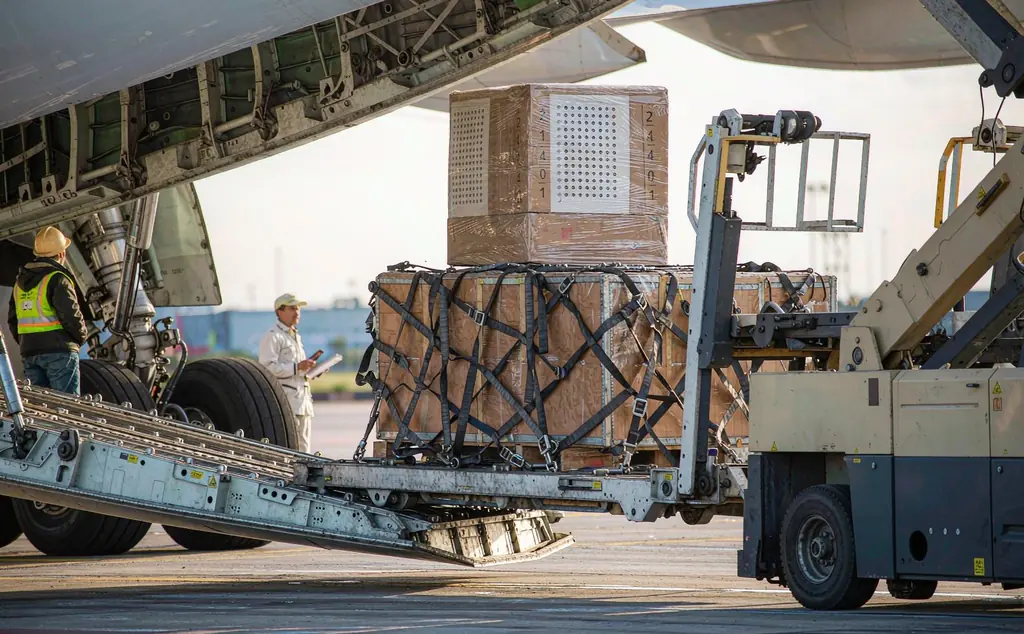
Magnetized material is regulated for transport independently of export control. Under the IATA dangerous-goods rules for UN2807, a consignment is only acceptable for air freight if its magnetic field is below 0.002 gauss measured at 2.1 m, or 0.00525 gauss measured at 4.6 m, from the package surface.
In practice this means:
- Strong magnets will need shielding — typically a ferromagnetic enclosure — to bring the field under the limit
- The measurement must be taken on the final packed configuration. Repacking invalidates the test
- Airlines reject on the flux measurement, not on the paperwork. A perfect invoice does not get a shielded pallet onto an aircraft
- Sea freight avoids the flux limit, but some carriers still request a declaration for strong magnets
Where the schedule allows, shipping by sea is usually simpler and cheaper for dense magnet cargo. Where it does not, plan the shielding and the flux test into the packing stage rather than discovering the problem at the freight forwarder’s warehouse.
Five Red Flags in a Supplier’s Paperwork
1. “No licence needed” with no test report. A verbal classification is not a classification. Ask for the report or assume the goods are controlled.
2. The composition is described by grade name. “SH, so it’s fine” is exactly the reasoning that fails when the producer uses terbium-based grain boundary diffusion.
3. A test report without a method or a detection limit. Without those two fields, “not detected” is unverifiable — and unverifiable means indefensible.
4. A vague invoice description. If you cannot tell from the invoice what is in the box, neither can a customs officer.
5. Pressure to ship before the documents are ready. Release from port is not the end of the process: customs retains post-release audit authority for three years in China, and several published penalty decisions concern shipments that had already left the country. Urgency is a commercial pressure, not a legal defence.
Pre-Shipment Checklist
- ☐ Composition of the actual production lot confirmed by accredited laboratory
- ☐ Dy and Tb measured numerically, with method and detection limit stated
- ☐ Test report tied to the lot or batch identification on the packing list
- ☐ Written control classification statement obtained from the supplier
- ☐ Export licence obtained and matching the item, quantity and consignee (controlled items)
- ☐ Commercial invoice description specific: material, grade, dimensions, coating, application
- ☐ Controlled and uncontrolled items declared separately
- ☐ HS code confirmed with the destination broker, including national tariff line
- ☐ Certificate of origin requested
- ☐ Magnetic flux measured on the final packed configuration, at 2.1 m and 4.6 m
- ☐ Shielding applied and re-tested if the configuration changed
- ☐ Destination-market substance declarations (RoHS / REACH) on file
Frequently Asked Questions
Do I need the dual-use control code, or is the HS code enough? You need both, for different purposes. The HS code governs duty and statistics; the control code governs whether the goods may be exported from China. A controlled NdFeB magnet carries both — for example HS 8505.11 and control code 1C905.
Is HS 8505.11 correct for both NdFeB and SmCo magnets? At the six-digit level, yes: 8505.11 covers permanent magnets of metal, which includes sintered NdFeB and SmCo. National tariff lines may then split further, so confirm the destination line with your broker.
How often should magnets be re-tested for dysprosium and terbium? Every distinct production lot should be traceable to a test. Composition can vary between lots, particularly where recycled feedstock or grain boundary diffusion is involved, so a single report reused across a year of shipments is a weak position.
Our shipment is HRE-free. Do we still need all this paperwork? Yes. Licensing and inspection are separate controls, and customs screens magnet cargo — including with handheld XRF analysers at the port — regardless of whether a licence was required. The composition report is what turns “trust us” into a verifiable classification.
Can the testing be done on the finished assembly rather than the magnet? Testing a finished assembly gives a less specific result, because the measurement is diluted by the surrounding materials. Where a classification decision has to be defended, test the magnet lot itself.
Key Takeaways
- Run two classification systems in parallel: the HS code for duty, the dual-use control code for export authorisation.
- 8505.11 for metal magnets (NdFeB, SmCo, AlNiCo); 8505.19 for non-metal. The binder, not the rare earth, decides the bonded-magnet case.
- The composition report must state method, detection limit, measured values and lot traceability — otherwise it is a claim, not evidence.
- Describe the goods specifically, and never mix controlled and uncontrolled items on one line. Careless descriptions, not concealment, are the leading cause of penalties.
- UN2807 is a separate gate. Flux limits apply at 2.1 m and 4.6 m, and repacking invalidates the measurement.
- Released is not cleared. China’s customs post-release audit window is three years.
Sources
- HS heading 8505 (permanent magnets and articles intended to become permanent magnets after magnetisation), subheadings 8505.11, 8505.19, 8505.20 and 8505.90; national tariff lines as published by customs authorities
- MOFCOM & GACC Announcement No. 18 of 2025 (export control on samarium, gadolinium, terbium, dysprosium, lutetium, scandium and yttrium items), effective 4 April 2025
- MOFCOM FAQ documents on the scope of rare earth export controls
- China customs enforcement decisions involving Dy/Tb classification of NdFeB shipments (2026), including Dy content of 0.15%, 0.18% and 0.372%
- Customs Audit Regulations of the PRC (post-release audit authority: three years)
- IATA Dangerous Goods Regulations, UN2807 (magnetized material): magnetic field limits of 0.002 gauss at 2.1 m and 0.00525 gauss at 4.6 m from the package
- Trade press reporting on customs deployment of handheld XRF analysers for dual-use item screening at ports, 2026
Last updated: September 2026. Tariff treatment, control scope and transport rules change frequently — confirm the current position with your broker, your laboratory and your supplier before shipping. This article is a practical procurement aid, not legal or customs advice.
Leave a Reply