Last updated: September 2026. Export control regulations change over time — always confirm the current requirements with your supplier before placing an order. This article is for general information only and does not constitute legal advice.
If you buy neodymium magnets from China, you may have heard that exports have become “more complicated” since 2025 — and you may be wondering what exactly is controlled, whether your magnets need an export license, and how this affects your lead times.
The short version: since April 4, 2025, certain NdFeB magnets — specifically those containing terbium (Tb) or dysprosium (Dy) — as well as SmCo magnets, are subject to China’s export licensing regime under Announcement No. 18 of 2025 issued by the Ministry of Commerce (MOFCOM) and the General Administration of Customs (GACC). Magnets that do not contain these heavy rare earth elements are, based on the announcement and official clarifications, outside the controlled magnet categories.
This guide explains, from a manufacturer’s perspective, what is controlled, which grades need a license, how long the licensing process actually takes, what documents matter, and how to plan your procurement around it.
What Is Announcement No. 18?
On April 4, 2025, China’s MOFCOM and GACC jointly issued Announcement No. 18, imposing export controls on items related to seven medium- and heavy-rare-earth elements: samarium (Sm), gadolinium (Gd), terbium (Tb), dysprosium (Dy), lutetium (Lu), scandium (Sc), and yttrium (Y).
Export controls do not mean a ban. Controlled items can still be exported legally — but each shipment requires an export license from MOFCOM, and the control code must be declared to customs. If customs questions the classification, the goods are held until the query is resolved.
For magnet buyers, three categories in the announcement matter most:
| Controlled item | Control code | What it covers |
|---|---|---|
| Samarium–cobalt permanent magnet materials | 1C902.a.4 | SmCo magnets and magnet powder (our SmCo range) |
| NdFeB permanent magnet materials containing terbium | 1C904.a.4 | NdFeB magnets and magnet powder containing Tb |
| NdFeB permanent magnet materials containing dysprosium | 1C905.a.4 | NdFeB magnets and magnet powder containing Dy |
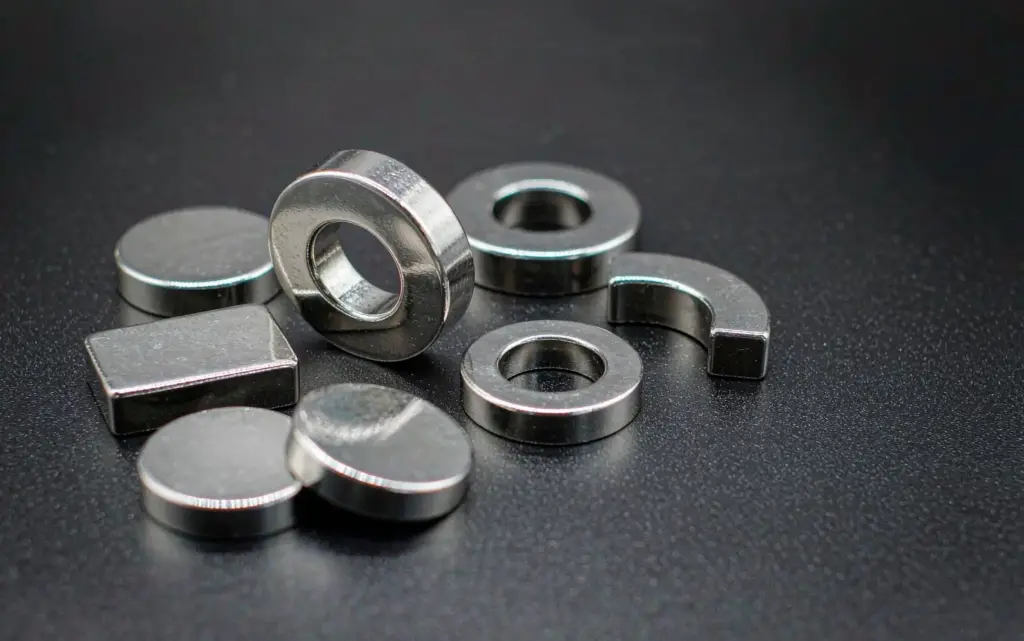
Under the official FAQ issued by MOFCOM (FAQ No. 4 on dual-use items, April 21, 2025), the scope of “permanent magnet materials” includes magnets and magnet powder, and extends to primary processed products made from these magnets — such as segments, tiles, rings and related magnetic assemblies. Products that involve deeper processing into finished components — for example, electric motors, speakers or headphones — fall outside the controlled magnet categories.
Does Your NdFeB Magnet Need an Export License?
In practice, the decisive question is: does your magnet contain terbium or dysprosium? Terbium and dysprosium are added to NdFeB to raise coercivity, which is what allows a magnet to keep its strength at higher operating temperatures. The higher the temperature rating of the grade, the more likely it contains one or both of these elements.
One practical caution: customs enforcement decisions in 2025–2026 have treated NdFeB magnets with heavy rare earth content above 0.1% as controlled items. There is no officially published minimum threshold for magnets in the announcement itself, so the safe approach is to treat any Dy/Tb content as potentially controlled and let a documented composition test — not assumptions — decide the classification.
Real-world example: In 2026, a Chinese trading company declared exported “magnetic hooks” as unrestricted goods. Customs testing found the embedded NdFeB magnets contained dysprosium above the level used in enforcement practice. The shipment was classified as a controlled item, and the company was fined. Several similar cases — including magnets misdeclared as Dy-free — have been penalized. Misclassification creates risk for everyone in the chain, including you as the buyer.
Which Grades Are Controlled? A Manufacturer’s Guide NEW
Grade designations are the fastest way to get a preliminary answer — although the final answer always comes from a composition test. The table below reflects how our own standard production is formulated, and where each grade series typically falls under the controls.
| Grade series | Typical max. operating temp. | Heavy rare earth content in our standard production | Export license |
|---|---|---|---|
| N (N35–N52) | ~80 °C | None | Not controlled |
| M (M35–M50) | ~100 °C | None | Not controlled |
| H (H35–H48) | ~120 °C | None | Not controlled |
| SH (SH35–SH45) | ~150 °C | None in our standard production | Not controlled — confirm by test |
| UH (UH30–UH40) | ~180 °C | Dy and/or Tb | Controlled (1C904 / 1C905) |
| EH (EH28–EH35) | ~200 °C | Dy and/or Tb | Controlled (1C904 / 1C905) |
| AH / higher | ~230 °C | Dy and/or Tb | Controlled (1C904 / 1C905) |
In short: SH and below is normally outside the controls; UH and above normally requires a license. Two caveats matter here:
- The classification is content-based, not grade-based in law. The announcement controls material containing Dy/Tb — so the grade name is only a starting point. A composition test is what customs will rely on.
- Additions vary by supplier and by part. A grade supplied by one plant may be formulated differently from the same grade at another. If your project is temperature-critical, confirm the actual composition of the specific part you are buying, not just the grade label. You can compare grade properties with our magnet grade comparison tool.
If your design does not require UH or higher, specifying SH or below in our standard formulation keeps the part outside the licensing regime — simpler documentation, and no licensing delay. Our engineers can review your operating temperature and geometry and tell you which route applies. See our NdFeB magnet range →
How Long Does the License Actually Take? Plan for About Four Months NEW
Most articles on this topic say timelines “vary.” In our experience handling these applications through 2025 and 2026, the realistic end-to-end processing time for an export license for controlled magnets is around four months.
That number drives everything about your planning, so it is worth being blunt about it: if your project needs UH-grade or higher magnets and your schedule is tighter than about five months, you have a problem to solve early — not at the shipping stage.
| Stage | What happens | Plan for |
|---|---|---|
| Specification & composition test | Grade confirmed, sample tested for Dy/Tb content | 1–2 weeks |
| License application & approval | Exporter applies to MOFCOM; documents and end-use information reviewed | ~4 months (our recent experience) |
| Production | Your parts are manufactured and inspected | your supplier’s standard lead time (fill in your actual figure) |
| Shipping | Export declaration with control code; customs may query during the process | Per destination and freight mode |
Two practical consequences:
- Start the conversation 5–6 months before your need date for controlled parts. Design freeze, sample approval and licensing should run in parallel, not in sequence.
- Ask your supplier to state the licensing step explicitly in the quotation. A quote that silently assumes 30-day delivery for a UH-grade part is a schedule risk, not a price advantage.
If Your Schedule Is Tight: The HRE-Free Route
Because dysprosium and terbium are the elements that put NdFeB magnets under control — and the reason for the four-month licensing path — there is growing buyer interest in HRE-free (heavy rare earth free) NdFeB grades: grades engineered to reach a given coercivity and operating temperature without Dy/Tb additions, typically through grain boundary diffusion and tighter process control.
Whether this route is viable depends on your application:
- Maximum operating temperature and temperature coefficients required
- Shape and dimensional factors (which drive demagnetization risk at corners and thin sections)
- Whether the design can accept a slightly different grade or coating package
For applications that fit, HRE-free grades can remove the licensing step from the critical path and reduce exposure to heavy rare earth price volatility. It is an engineering trade-off, not a free win — but it is worth raising with your supplier’s technical team at the design stage, when a change is still cheap. Ask us to evaluate your operating conditions →
Documents to Request from Your Supplier
A compliant supplier should be able to provide these without hesitation:
| Document | Why it matters |
|---|---|
| Composition test report (third-party or in-house with test method stated) | Confirms whether Dy/Tb are present and at what level — the basis of the control classification |
| Material grade & specification sheet | Links the test report to your actual order (grade, coating, dimensions) |
| Control classification statement | Whether the product falls under 1C902/1C904/1C905 and, if so, the control code to be declared |
| Export license (for controlled shipments) | Confirms the shipment is licensed; buyers importing into regulated sectors may need this for their own compliance records |
| Correct HS classification (reference: 8505.11 for permanent metal magnets) | Consistent declaration reduces the chance of customs queries |
Our own practice: composition testing for controlled-material classification is carried out at the customs-affiliated testing center in Ningbo — the laboratory whose reports customs itself relies on. For customer orders involving Dy/Tb-containing material, the test report travels with the shipment documentation, so there is a verifiable link between what was declared and what is in the box.
Why Cutting Corners Will Cost You More
Since 2025, Chinese customs has published a steady stream of penalty decisions involving NdFeB exports: magnets misdeclared by product name, contents declared as Dy-free that tested positive, and express shipments of sample quantities. Penalties have ranged from fines and confiscation to forced re-export of goods — and under China’s Export Control Law, serious cases can escalate further.
For a buyer, the practical risks are concrete:
- Seizure or return of your goods — your production line waits while the shipment is resolved.
- Sudden supplier loss — a supplier caught violating export controls may be unable to ship for an extended period.
- Compliance exposure on your side — if you import magnets into automotive, medical or defense-adjacent supply chains, your own customers increasingly audit the sourcing chain.
Choosing a supplier with a documented, compliant export process is now a procurement decision, not just a quality decision.
Frequently Asked Questions
Are NdFeB magnets banned from export by China?
No. Export controls are not a ban. Controlled magnets — SmCo magnets, and NdFeB magnets containing Dy or Tb — can be exported legally with a license from MOFCOM for each shipment. NdFeB magnets that do not contain Dy or Tb are outside the controlled magnet categories based on the announcement and official clarifications.
Which grades need an export license?
In our standard production, N, M, H and SH grades contain no Dy or Tb and are outside the controls; UH, EH and AH grades contain Dy and/or Tb and are controlled. Because the law is based on content rather than grade name, confirm the specific part by composition test.
How long does the export license take?
Based on our applications through 2025 and 2026, plan for around four months. There is no officially published processing time, so build the licensing step into your project schedule explicitly rather than treating it as paperwork at the shipping stage.
My magnets are just small consumer parts. Do the rules still apply?
Yes. The controls apply to the magnet material itself, including magnet powder and primary processed products like segments, rings and magnetic assemblies. Quantity does not matter — enforcement cases include small express shipments. Only products that are deeper-processed into finished devices (motors, speakers, etc.) fall outside the magnet categories.
Has anything changed since the announcement?
Export control policies continue to evolve, and additional announcements and clarifications have been issued since April 2025. This is exactly why the “last updated” date on this page matters, and why you should confirm current requirements with your supplier at order time.
Key Takeaways for Buyers
- Since April 4, 2025, SmCo magnets and NdFeB magnets containing Dy/Tb require an export license for every shipment from China.
- SH and below: normally not controlled. UH and above: normally requires a license. Composition testing decides the final answer.
- Plan around four months for the licensing process on controlled parts — start 5–6 months before your need date.
- Request documentation — composition test report, classification statement, and license for controlled shipments — as a standard part of your procurement process.
- If your schedule cannot absorb the licensing time, evaluate HRE-free NdFeB grades with your supplier’s engineers at the design stage.
Need magnets that ship cleanly and on schedule? Contact HS Hardwares — we manufacture NdFeB, SmCo and magnetic assemblies under a documented, compliant export process, and we will tell you exactly which category your parts fall into before you order.
Contact Us
Hangzhou HS Hardwares Co., Ltd.
NdFeB Magnets · SmCo Magnets · Magnetic Assemblies · Precision Stamping Parts
- Email: info@hshardwares.com
- Phone / WhatsApp: +86-13666656994
- Website: www.hs-hardwares.com
Send us your drawing or specification — we will confirm the material classification, export requirements and a realistic delivery schedule within one business day.
Sources
• MOFCOM & GACC Announcement No. 18 of 2025 — Decision on Implementing Export Controls on Certain Medium- and Heavy-Rare-Earth Related Items (April 4, 2025), mofcom.gov.cn
• MOFCOM, FAQ No. 4 on Dual-Use Items (Rare Earths) (April 21, 2025), mofcom.gov.cn
• Customs penalty decisions published by Ningbo, Xiamen and Shanghai customs (2025–2026), customs.gov.cn
• Grade classification and licensing timelines in this article reflect HS Hardwares’ own production and export experience, 2025–2026.
Leave a Reply