
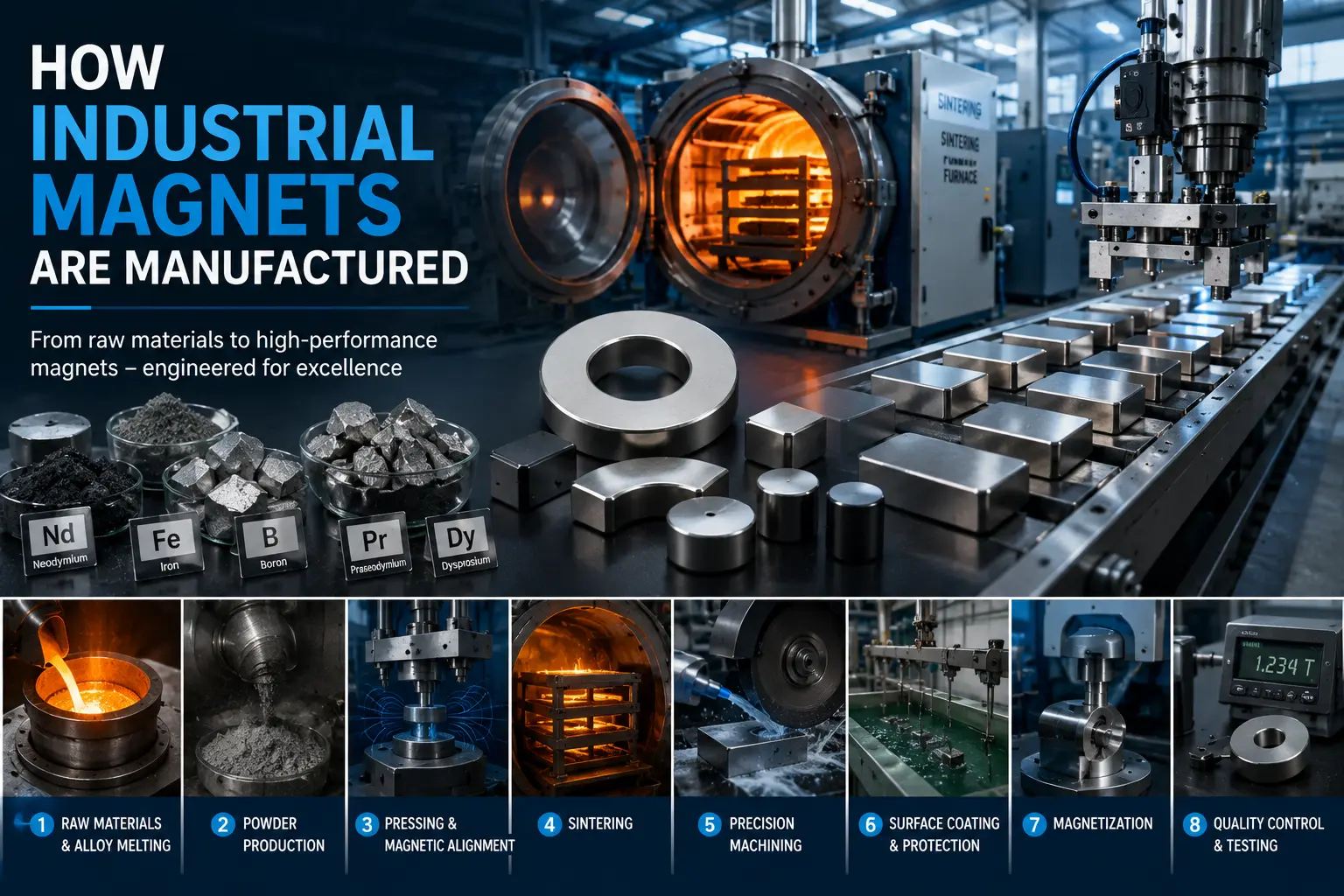
Industrial magnets play a critical role in modern technology, powering everything from electric motors and sensors to renewable energy systems and medical equipment. While magnets may appear simple, their manufacturing process involves advanced material science, precision engineering, and strict quality control. Understanding how industrial magnets are manufactured can help engineers and buyers select the right magnetic solution for their applications.
Step 1: Raw Material Preparation
The manufacturing process begins with carefully selected raw materials. The specific materials depend on the magnet type being produced.
Common industrial magnet materials include:
- Neodymium Iron Boron (NdFeB)
- Samarium Cobalt (SmCo)
- Ferrite (Ceramic)
- Alnico
For rare-earth magnets such as NdFeB and SmCo, high-purity rare-earth elements are combined with iron, cobalt, boron, or other alloying materials to achieve the desired magnetic properties.
Step 2: Alloy Melting and Casting
The raw materials are melted in a vacuum induction furnace to prevent contamination and oxidation. The molten alloy is then cast into molds or rapidly cooled to form solid metal ingots.
Maintaining precise chemical composition during this stage is critical because even small variations can significantly affect magnetic performance.
Step 3: Pulverization and Powder Production
For sintered rare-earth magnets, the alloy ingots are crushed and milled into extremely fine powder.
This powder production process creates particles that can be aligned during later stages to maximize magnetic strength. Advanced milling technologies help achieve uniform particle size distribution and consistent magnetic characteristics.
Step 4: Pressing and Magnetic Alignment
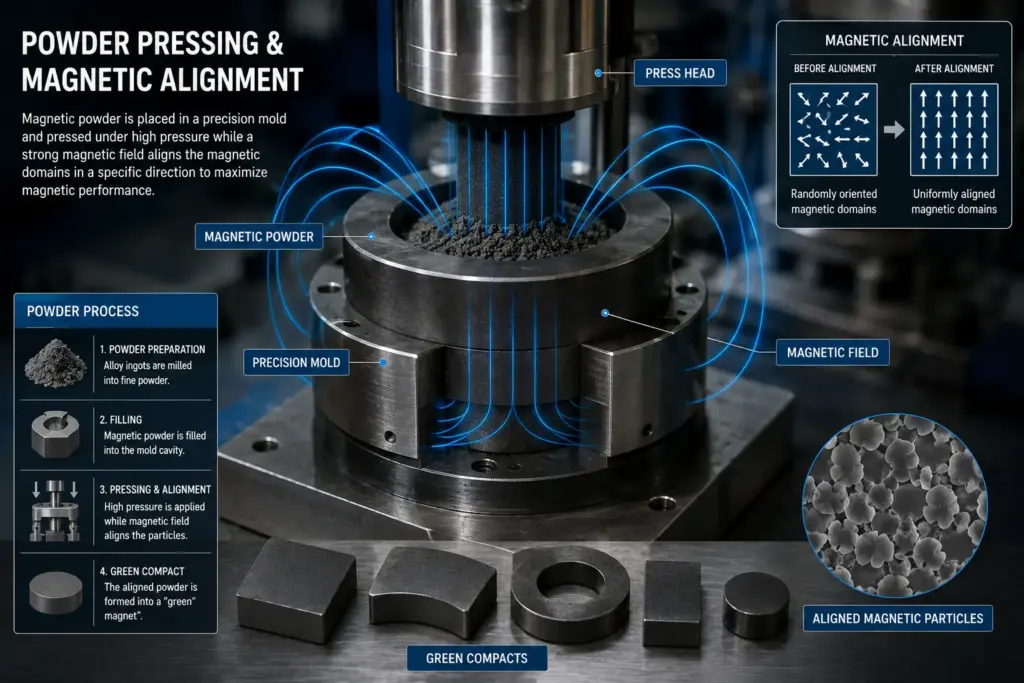
The magnetic powder is placed into specialized molds and compressed under high pressure.
During pressing, a strong magnetic field is applied to align the magnetic domains in a specific direction. This alignment determines whether the finished magnet will be isotropic or anisotropic and directly impacts its magnetic performance.
The result is a compacted “green” magnet that has the desired shape but has not yet reached its final strength.
Step 5: Sintering
The pressed magnets are heated in a controlled atmosphere furnace at high temperatures.
During sintering, the powder particles bond together, increasing density and improving magnetic properties. The process also enhances mechanical strength and structural stability.
After sintering, the magnets undergo controlled cooling to optimize their microstructure and magnetic performance.
Step 6: Precision Machining
Because sintered magnets become extremely hard and brittle, machining is typically performed after sintering using diamond grinding equipment.
Common machining operations include:
- Surface grinding
- Cutting
- Drilling
- Slotting
- Chamfering
Precision machining ensures that magnets meet strict dimensional tolerances required by industrial applications.
Step 7: Surface Coating and Protection
Many industrial magnets require protective coatings to prevent corrosion and environmental damage.
Popular coating options include:
- Nickel-Copper-Nickel (Ni-Cu-Ni)
- Epoxy
- Zinc
- Gold
- Parylene
The coating selection depends on operating conditions, humidity levels, chemical exposure, and application requirements.
Step 8: Magnetization
Before use, the finished components are exposed to an extremely powerful magnetic field generated by specialized magnetizing equipment.
This process aligns the internal magnetic domains and gives the magnet its permanent magnetic properties.
Different magnetization patterns can be applied, including:
- Axial magnetization
- Diametrical magnetization
- Multi-pole magnetization
- Radial magnetization
Step 9: Inspection and Quality Control
Quality assurance is essential throughout the manufacturing process.
Manufacturers perform comprehensive inspections, including:
- Dimensional measurements
- Magnetic property testing
- Flux density verification
- Coating thickness inspection
- Visual quality checks
Advanced testing equipment ensures that every magnet meets customer specifications and international quality standards.
Conclusion
The manufacturing of industrial magnets is a sophisticated process that combines metallurgy, precision engineering, and advanced quality control. From raw material preparation and powder pressing to coating and magnetization, each step plays a vital role in determining the magnet’s final performance. By understanding how industrial magnets are manufactured, engineers and procurement teams can make more informed decisions when selecting reliable magnetic solutions for demanding industrial applications.
Leave a Reply