Industrial magnets are essential components in countless applications, from electric motors and automotive systems to medical devices and renewable energy equipment. The performance, reliability, and lifespan of your products often depend on the quality of the magnets used. Choosing the right magnet manufacturer is therefore a critical decision that can directly impact your supply chain, production costs, and overall product performance.
With numerous suppliers available worldwide, understanding how to evaluate a magnet manufacturer can help ensure a successful long-term partnership.
Evaluate Industry Experience and Expertise
One of the first factors to consider is the manufacturer’s industry experience. Companies with many years of experience typically possess deeper technical knowledge, more mature production processes, and a stronger understanding of various application requirements.
An experienced magnet manufacturer should be able to provide guidance on:
- Material selection
- Magnetic circuit design
- Performance optimization
- Cost reduction opportunities
- Manufacturing feasibility
A supplier that understands your industry can often identify potential challenges before they become costly problems.
Assess Manufacturing Capabilities
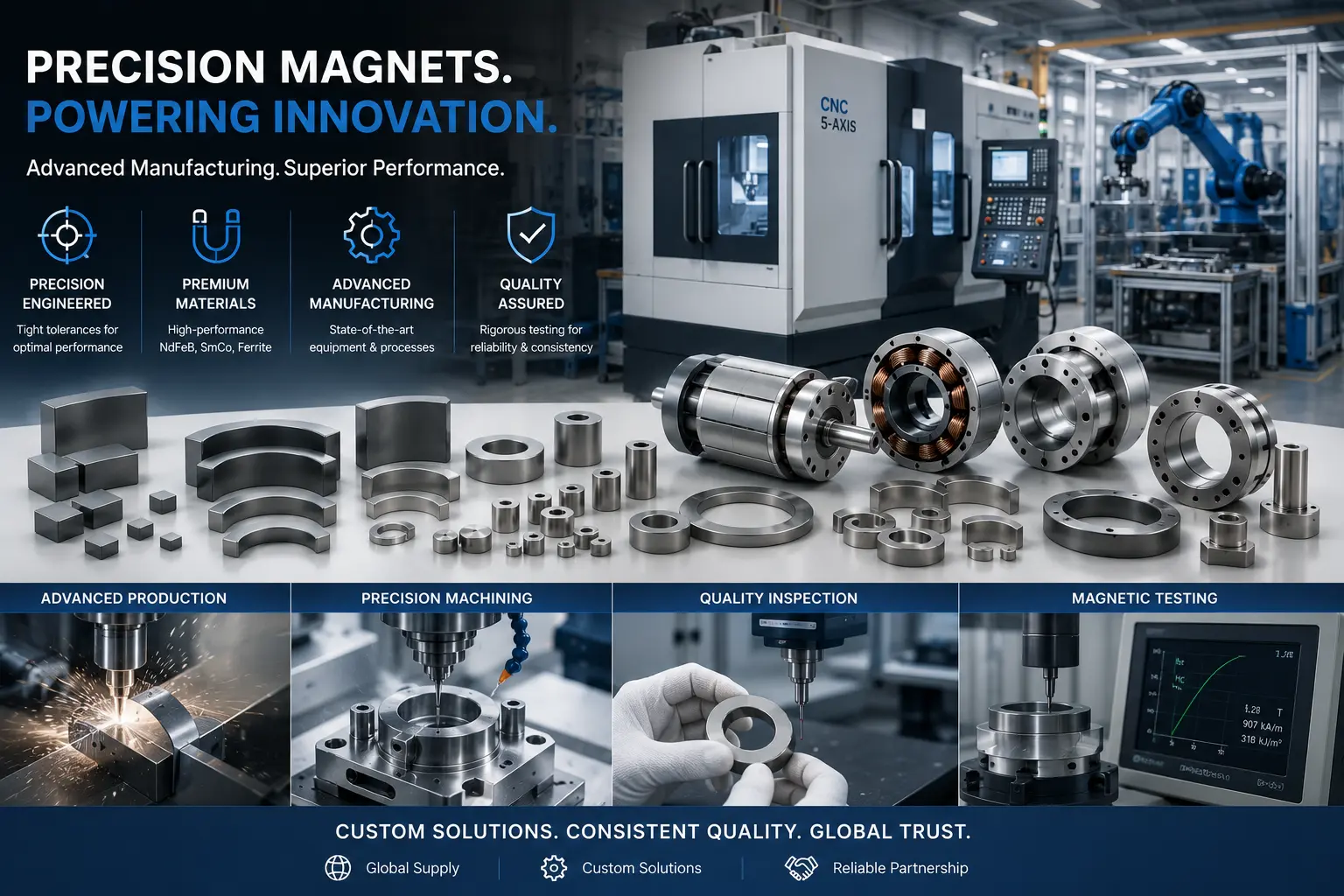
A reliable magnet manufacturer should have comprehensive production capabilities that cover the entire manufacturing process.
Key capabilities may include:
- NdFeB magnet production
- SmCo magnet production
- Ferrite magnet manufacturing
- Magnetic assemblies
- Precision machining
- Surface coating
- Magnetization services
Manufacturers with integrated production facilities typically offer better quality control, shorter lead times, and more competitive pricing.
Verify Quality Management Systems
Quality consistency is critical in industrial applications. Look for manufacturers that operate under internationally recognized quality management systems.
Important certifications may include:
- ISO 9001
- IATF 16949 (Automotive)
- ISO 14001
- RoHS Compliance
- REACH Compliance
A well-established quality system demonstrates the supplier’s commitment to process control and continuous improvement.
Review Testing and Inspection Capabilities
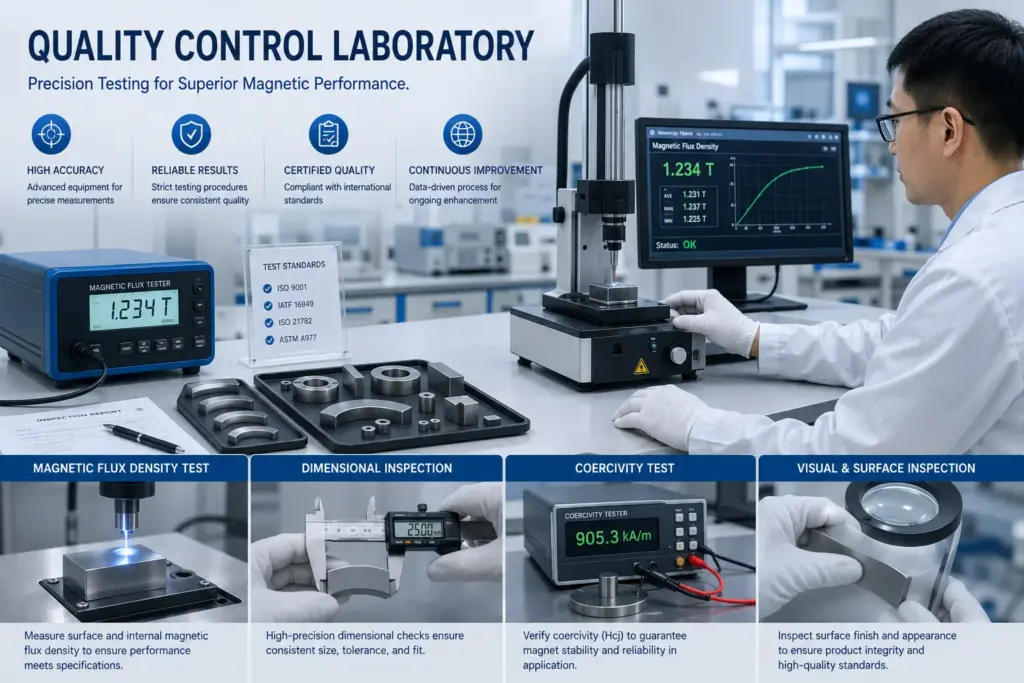
Reliable manufacturers invest heavily in quality assurance equipment and testing procedures.
Common inspection methods include:
- Flux density measurement
- Magnetic property testing
- Dimensional inspection
- Coating thickness testing
- Salt spray testing
- Material composition analysis
The ability to provide detailed inspection reports helps ensure that every shipment meets your specifications.
Consider Engineering and Customization Support
Many industrial applications require custom magnetic solutions rather than standard catalog products.
A strong engineering team should be able to assist with:
- Custom magnet design
- Prototype development
- Material recommendations
- Magnetization pattern design
- Magnetic assembly optimization
Manufacturers that offer technical support throughout the product development cycle can help reduce development time and improve product performance.
Evaluate Production Capacity and Delivery Reliability
Supply chain stability is increasingly important in today’s global market. Before selecting a supplier, assess their production capacity and delivery performance.
Questions to consider include:
- Can they support future volume growth?
- Do they maintain stable raw material sourcing?
- What are their average lead times?
- How do they handle urgent orders?
A dependable manufacturer should have systems in place to ensure consistent production and on-time delivery.
Examine Surface Coating Options
Industrial magnets often operate in demanding environments where corrosion resistance is critical.
Common coating options include:
- Nickel-Copper-Nickel (Ni-Cu-Ni)
- Zinc
- Epoxy
- Gold
- Parylene
The manufacturer should be able to recommend suitable coatings based on temperature, humidity, and environmental exposure requirements.
Review Customer Service and Communication
Effective communication is often overlooked but can significantly impact project success.
A reliable supplier should provide:
- Fast response times
- Technical consultation
- Clear project updates
- Transparent pricing
- After-sales support
Strong communication helps minimize misunderstandings and ensures smoother project execution.
Compare Total Value, Not Just Price
While pricing is always important, the lowest-cost supplier is not necessarily the best choice.
When evaluating suppliers, consider:
- Product quality
- Technical support
- Production capability
- Delivery reliability
- Quality certifications
- Long-term partnership potential
A slightly higher initial cost may result in significant savings through reduced defects, lower warranty claims, and improved operational efficiency.
Why Choose HS Hardwares?
At HS Hardwares, we combine over 20 years of manufacturing experience with advanced production technology to deliver high-performance magnetic solutions for global customers.
Our capabilities include:
- NdFeB Magnets
- SmCo Magnets
- Magnetic Assemblies
- Precision Stamping Parts
- Magnetic Motor Components
- Custom Magnetic Solutions
Supported by strict quality control systems and an experienced engineering team, we help customers develop reliable, cost-effective magnetic products tailored to their specific applications.
Conclusion
Choosing a reliable magnet manufacturer requires more than comparing prices. By evaluating experience, production capabilities, quality systems, engineering support, and delivery performance, businesses can build strong supplier partnerships that support long-term growth and product success.
Working with a trusted manufacturer such as HS Hardwares ensures access to high-quality magnetic solutions, technical expertise, and dependable service throughout the entire product lifecycle.
Leave a Reply