
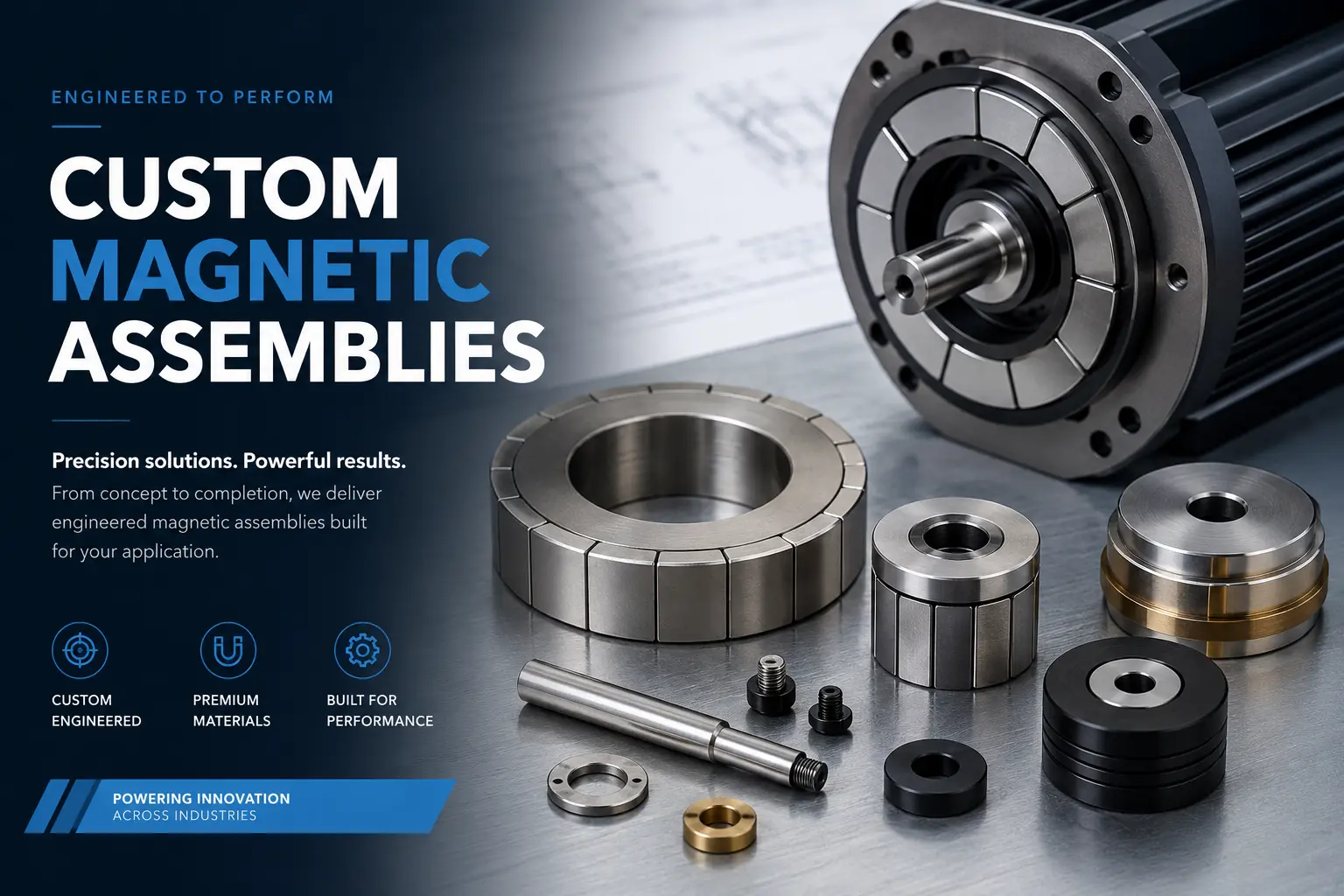
Magnetic assemblies are engineered products that combine permanent magnets with other materials such as steel, stainless steel, aluminum, plastic, or rubber to achieve specific magnetic functions and performance requirements.
Unlike standalone magnets, magnetic assemblies are designed to enhance magnetic force, improve durability, simplify installation, and optimize performance for industrial applications.
Today, magnetic assemblies are widely used in electric motors, automation equipment, automotive systems, medical devices, electronics, and industrial machinery.
How Do Magnetic Assemblies Work?
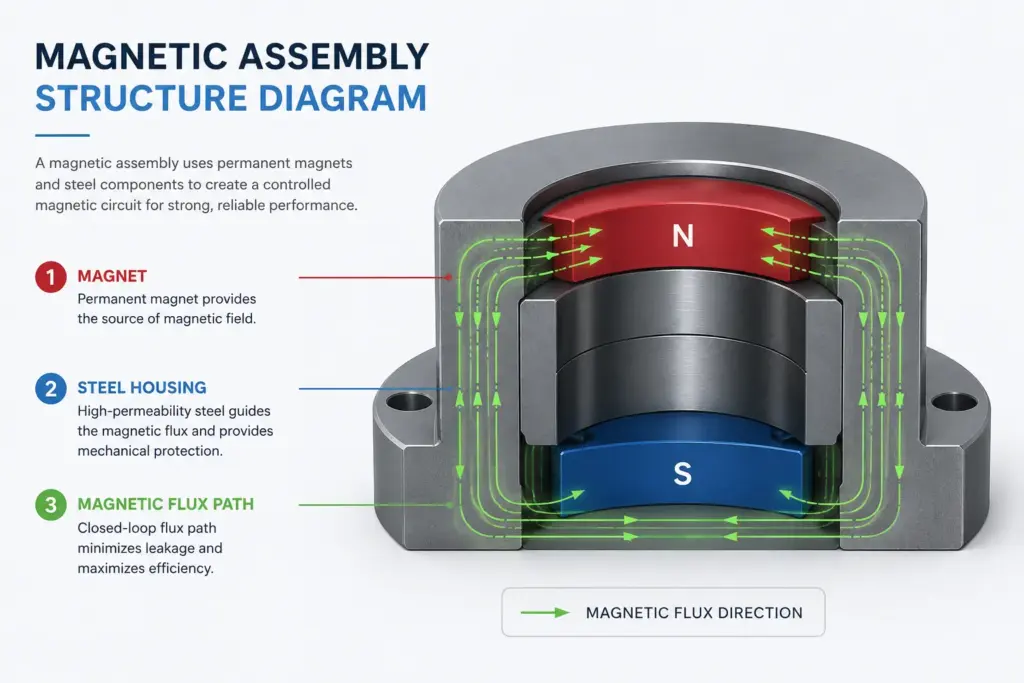
A magnetic assembly utilizes the magnetic field generated by permanent magnets and directs or concentrates that magnetic energy through specially designed components.
By incorporating materials such as low-carbon steel, magnetic circuits can be created to:
- Increase holding force
- Focus magnetic flux
- Reduce magnetic leakage
- Improve efficiency
- Protect magnets from damage
This combination often delivers significantly better performance than using a magnet alone.
Main Components of a Magnetic Assembly
A typical magnetic assembly may include:
Permanent Magnet
The core magnetic element.
Common materials include:
- NdFeB Magnets
- SmCo Magnets
- Ferrite Magnets
- AlNiCo Magnets
Steel Housing
Provides mechanical protection and enhances magnetic performance.
Mounting Components
Such as:
- Threaded studs
- Screws
- Mounting plates
- Brackets
Protective Coating
Used to improve corrosion resistance and service life.
Common coatings include:
- Nickel
- Zinc
- Epoxy
- Powder Coating
Types of Magnetic Assemblies
There are many types of magnetic assemblies designed for different industrial applications.
Magnetic Pot Assemblies
Pot magnets use a steel cup to concentrate magnetic force on one surface.
Applications:
- Workholding
- Fixtures
- Mounting systems
- Industrial equipment
Magnetic Rotor Assemblies
Magnetic rotors are commonly used in:
- Electric motors
- Generators
- Servo systems
- EV powertrains
They provide efficient torque generation and energy conversion.
Magnetic Couplings
Magnetic couplings transmit torque without physical contact.
Benefits include:
- No mechanical wear
- Reduced maintenance
- Improved sealing performance
Commonly used in pumps and fluid systems.
Magnetic Sensor Assemblies
Used in:
- Position sensors
- Speed sensors
- Hall effect devices
These assemblies provide precise magnetic field control.
Magnetic Holding Assemblies
Designed to securely hold or position objects.
Examples include:
- Magnetic clamps
- Magnetic catches
- Magnetic mounting systems
Custom Magnetic Assemblies
Engineered according to customer drawings and application requirements.
Custom designs often involve:
- Complex magnetic circuits
- Specialized housings
- Precision tolerances
- Multi-component integration
Advantages of Magnetic Assemblies
Enhanced Magnetic Performance
Magnetic circuits help maximize magnetic efficiency and holding force.
Improved Durability
The housing protects magnets from:
- Impact
- Vibration
- Corrosion
Easier Installation
Integrated mounting structures simplify assembly and maintenance.
Reduced System Cost
Combining multiple functions into one assembly reduces overall component count.
Customized Functionality
Assemblies can be designed for specific application requirements.
Common Magnetic Materials Used
NdFeB Magnets
Advantages:
- Highest magnetic strength
- Compact size
- Excellent energy density
Typical applications:
- Motors
- Automation systems
- Electronics
SmCo Magnets
Advantages:
- High temperature resistance
- Excellent corrosion resistance
Typical applications:
- Aerospace
- Medical equipment
- Defense systems
Ferrite Magnets
Advantages:
- Low cost
- Good corrosion resistance
Typical applications:
- Consumer products
- General industrial equipment
Industrial Applications of Magnetic Assemblies
Electric Motors
Magnetic assemblies are critical components in:
- Servo motors
- Permanent magnet motors
- EV motors
- Industrial drives
They improve efficiency and power density.
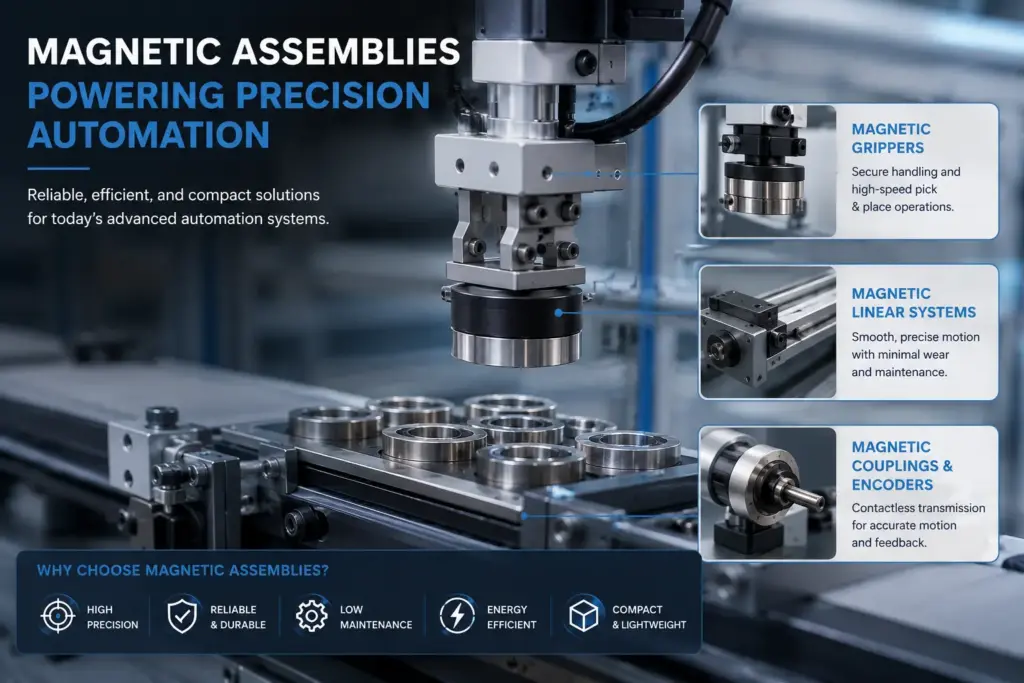
Automation Equipment
Used in:
- Robotics
- Pick-and-place systems
- Linear actuators
- Production machinery
Automotive Industry
Applications include:
- Electric power steering
- Sensors
- Electric pumps
- Motor systems
Medical Devices
Magnetic assemblies are found in:
- Diagnostic equipment
- Laboratory instruments
- Imaging systems
Renewable Energy
Widely used in:
- Wind turbine generators
- Energy storage systems
- Power conversion equipment
Magnetic Assembly Manufacturing Process
The manufacturing process typically includes:
Design & Engineering
Magnetic simulation and structural design.
Material Selection
Choosing appropriate magnets and housing materials.
Precision Machining
Producing components according to design specifications.
Assembly Process
Integrating magnets with housings and mechanical parts.
Performance Testing
Testing includes:
- Magnetic flux measurement
- Pull force testing
- Dimensional inspection
- Environmental testing
Packaging & Delivery
Products are packaged to prevent damage during transportation.
Key Considerations When Designing Magnetic Assemblies
Before developing a magnetic assembly, engineers should evaluate:
Magnetic Force Requirements
Determine the required holding force or magnetic field strength.
Operating Environment
Consider:
- Temperature
- Humidity
- Corrosion exposure
- Vibration
Space Constraints
Optimize magnetic performance within available installation space.
Mechanical Requirements
Evaluate:
- Mounting methods
- Structural strength
- Load conditions
Cost Efficiency
Balance performance, manufacturability, and project budget.
Why Choose Custom Magnetic Assemblies?
Standard products may not always meet application requirements.
Custom magnetic assemblies provide:
- Optimized performance
- Better system integration
- Reduced assembly time
- Improved reliability
- Lower overall operating costs
For OEM manufacturers, customized solutions often create significant competitive advantages.
Why Work With an Experienced Magnetic Assembly Manufacturer?
An experienced manufacturer can provide:
- Engineering support
- Magnetic circuit optimization
- Material selection guidance
- Prototype development
- OEM & ODM services
- Consistent quality control
Choosing the right partner helps reduce development risk and accelerate product commercialization.
Conclusion
Magnetic assemblies combine the power of permanent magnets with engineered structures to deliver enhanced performance, reliability, and functionality. From industrial motors and automation systems to medical equipment and renewable energy applications, magnetic assemblies play an essential role in modern manufacturing and technology.
By understanding assembly types, materials, design considerations, and manufacturing processes, engineers and buyers can select the most suitable magnetic assembly solution for their specific applications.
Leave a Reply