
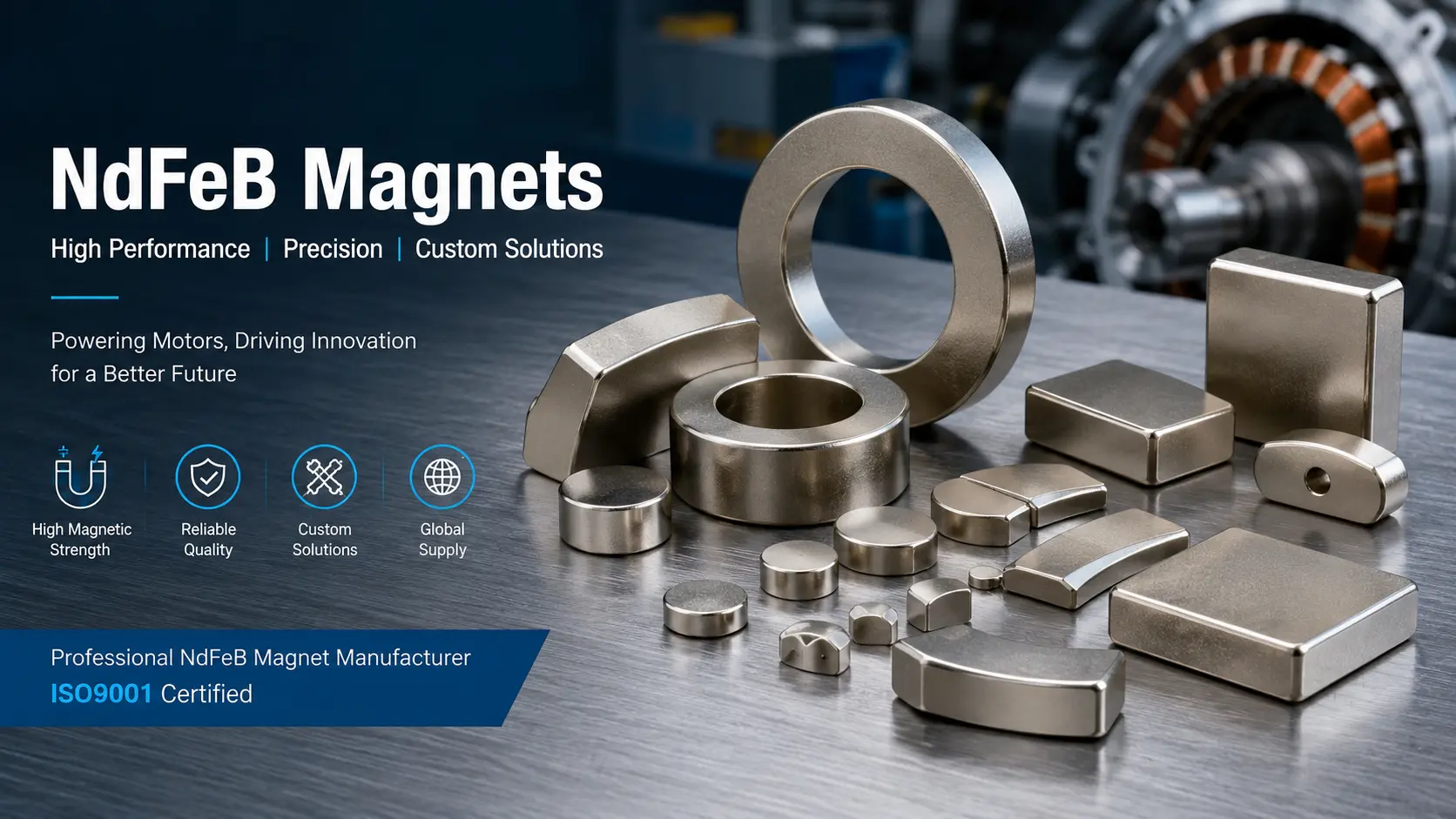
NdFeB magnets, also known as Neodymium Iron Boron magnets or Neodymium magnets, are the strongest commercially available permanent magnets in the world. They are made primarily from neodymium (Nd), iron (Fe), and boron (B), forming a powerful rare-earth magnetic material with exceptional magnetic performance.
Since their commercial introduction in the 1980s, NdFeB magnets have become an essential component in modern industries, including electric vehicles, industrial motors, renewable energy systems, consumer electronics, automation equipment, and medical devices.
Their high magnetic strength, compact size, and excellent energy efficiency make them the preferred choice for applications requiring strong magnetic fields in limited spaces.
What Does NdFeB Stand For?
The name NdFeB comes from the chemical elements used in the material:
- Nd – Neodymium
- Fe – Iron
- B – Boron
These elements are combined through advanced metallurgical processes to create a powerful permanent magnetic material with outstanding magnetic properties.
Key Characteristics of NdFeB Magnets
NdFeB magnets offer several advantages compared to other permanent magnet materials.
Extremely High Magnetic Strength
NdFeB magnets provide the highest magnetic energy product among commercially available permanent magnets, allowing smaller magnets to generate stronger magnetic forces.
Excellent Energy Efficiency
Their strong magnetic field enables designers to reduce component size and weight while maintaining high performance.
Wide Range of Grades
NdFeB magnets are available in various grades to meet different performance requirements, from standard applications to high-temperature environments.
Versatile Manufacturing Options
They can be manufactured in various shapes and sizes, including:
- Disc magnets
- Ring magnets
- Block magnets
- Arc magnets
- Countersunk magnets
- Custom-shaped magnets
How Are NdFeB Magnets Manufactured?
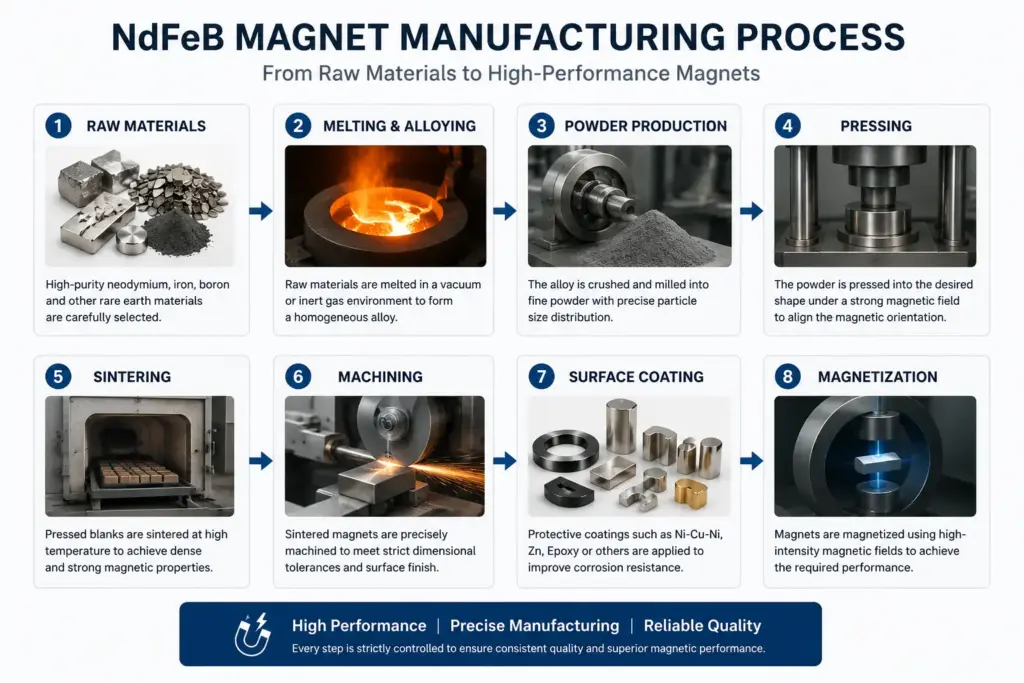
The production of NdFeB magnets involves multiple precision-controlled processes.
Raw Material Preparation
Rare earth materials, iron, and boron are carefully selected and mixed according to specific formulations.
Melting and Alloy Formation
The raw materials are melted under controlled conditions to create a homogeneous alloy.
Pulverization
The alloy is crushed into extremely fine powder.
Pressing and Sintering
The powder is compressed under a magnetic field and sintered at high temperatures to form solid magnetic components.
Machining
Precision grinding, cutting, and machining processes are used to achieve required dimensions and tolerances.
Surface Coating
Since NdFeB magnets are susceptible to corrosion, protective coatings are applied.
Common coatings include:
- Nickel-Copper-Nickel (Ni-Cu-Ni)
- Epoxy
- Zinc
- Gold
- Parylene
Magnetization
The finished magnets are exposed to a strong magnetic field to achieve their desired magnetic properties.
Understanding NdFeB Magnet Grades
NdFeB magnets are classified by grades that indicate their magnetic performance.
Common grades include:
| Grade | Typical Application |
|---|---|
| N35 | General industrial use |
| N38 | Electronics and sensors |
| N42 | Motors and automation |
| N48 | High-performance devices |
| N52 | Maximum magnetic strength |
For high-temperature applications, specialized grades are available:
- N35H
- N38SH
- N42UH
- N35EH
- N30AH
These grades maintain magnetic performance under elevated operating temperatures.
Temperature Resistance of NdFeB Magnets
Operating temperature is a critical factor when selecting a magnet.
| Grade Type | Maximum Operating Temperature |
|---|---|
| Standard | 80°C |
| H Grade | 120°C |
| SH Grade | 150°C |
| UH Grade | 180°C |
| EH Grade | 200°C |
| AH Grade | 230°C |
Selecting the correct temperature grade helps prevent irreversible demagnetization.
Common Applications of NdFeB Magnets
Electric Vehicle Motors
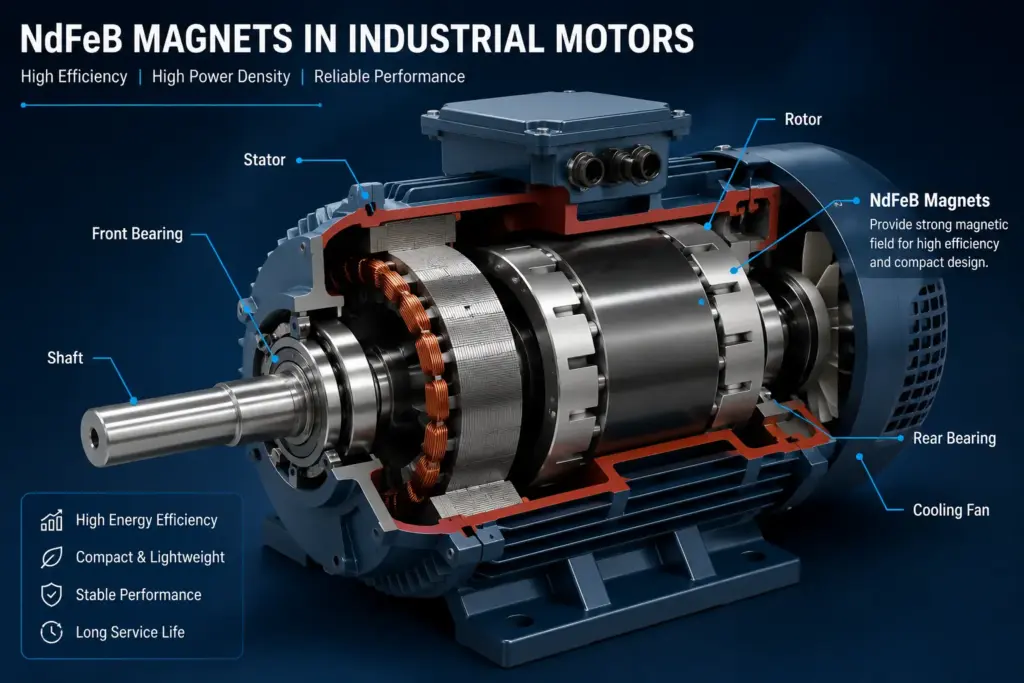
NdFeB magnets are widely used in EV traction motors due to their high power density and efficiency.
Industrial Motors
Permanent magnet motors benefit from improved efficiency, reduced energy consumption, and compact designs.
Automation Equipment
Robotics, actuators, and automated production systems rely on NdFeB magnets for precise motion control.
Renewable Energy Systems
Wind turbines and energy-generation equipment often utilize high-performance rare earth magnets.
Medical Devices
NdFeB magnets are used in imaging systems, surgical equipment, and diagnostic devices.
Consumer Electronics
Applications include:
- Smartphones
- Speakers
- Earbuds
- Hard drives
- Smart home products
Advantages of NdFeB Magnets
Strongest Permanent Magnet Available
NdFeB magnets provide significantly higher magnetic force than ferrite or AlNiCo magnets.
Compact Design
Smaller magnets can achieve the same performance as larger conventional magnets.
High Energy Density
They maximize magnetic output while minimizing material volume.
Cost-Effective Performance
For many industrial applications, NdFeB magnets offer the best balance between performance and cost.
NdFeB Magnets vs SmCo Magnets
| Feature | NdFeB Magnets | SmCo Magnets |
|---|---|---|
| Magnetic Strength | Higher | Slightly Lower |
| Corrosion Resistance | Requires Coating | Excellent |
| Temperature Resistance | Up to 230°C | Up to 350°C |
| Cost | Lower | Higher |
| Mechanical Strength | Better | More Brittle |
NdFeB magnets are generally preferred when maximum magnetic strength is required, while SmCo magnets are ideal for extreme temperature and corrosive environments.
Factors to Consider When Selecting NdFeB Magnets
Before choosing a magnet, evaluate:
Required Magnetic Force
Determine the magnetic flux density and holding force needed for your application.
Operating Temperature
Select an appropriate grade based on environmental conditions.
Coating Requirements
Consider humidity, chemicals, and corrosion exposure.
Magnet Shape
Different applications require different geometries for optimal performance.
Dimensional Tolerance
Precision applications may require tight machining tolerances.
Why Choose a Professional NdFeB Magnet Manufacturer?
A reliable manufacturer can provide:
- Consistent product quality
- ISO9001 quality management
- Custom sizes and shapes
- Engineering support
- Stable supply chain
- Competitive lead times
For industrial projects, working with an experienced manufacturer helps ensure product performance, quality consistency, and long-term reliability.
Conclusion
NdFeB magnets are the most powerful permanent magnets available today and play a vital role in modern industrial technologies. Their exceptional magnetic strength, compact size, and broad application range make them indispensable in electric vehicles, industrial motors, automation systems, renewable energy equipment, and countless other products.
By understanding magnet grades, temperature resistance, coatings, and application requirements, engineers and buyers can select the most suitable NdFeB magnet solution for their projects.
Leave a Reply